The Nuclear Family (2004)
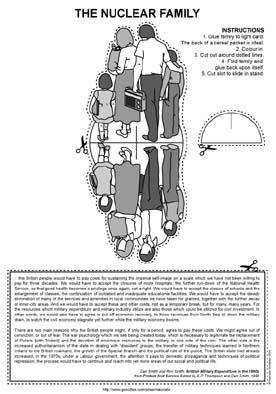
The family from Protect and Survive is reproduced as a free-standing model as The Nuclear Family. The text is taken from an essay in Protest and Survive, a book produced in response to the government's booklet, and in relation to the decision to base Cruise missiles in the UK. The essay, British Military Expenditure in the 1980s, describes what the consequences of increased defence spending would mean to the nation's economy, how finite resources would necessarily have to be redirected from civil investment in, among others, the health service and education, and how the British people's consent for this would have to be manufactured. The authors' predictions made in 1980 have turned out to have been broadly accurate.
The text at the bottom of the sheet reads:
..the British people would have to pay costs for sustaining the imperial self-image on a scale which we have not been willing to pay for three decades. We would have to accept the closures of more hospitals, the further run-down of the National Health Service, so that good health becomes a privilege once again, not a right. We would have to accept the closure of schools and the enlargement of classes, the continuation of outdated and inadequate educational facilities. We would have to accept the steady elimination of many of the services and amenities in local communities we have taken for granted, together with the further decay of inner-city areas. And we would have to accept these and other costs, not as a temporary break, but for many, many years. For the resources which military expenditure and military industry utilize are also those which could be utilized for civil investment. In other words, we would also have to agree to put off economic recovery, to throw revenues from North Sea oil down the military drain, to watch the civil economy stagnate yet further while the military economy booms.
There are two main reasons why the British people might, if only for a period, agree to pay these costs. We might agree out of conviction, or out of fear. The war psychology which we see being created today, which is necessary to legitimate the replacement of Polaris [with Trident] and the devotion of enormous resources to the military, is one side of the coin. The other side is the increased authoritarianism of the state in dealing with 'dissident' groups, the transfer of military techniques learned in Northern Ireland to the British mainland, the growth of the Special Branch and the political role of the police. The British state had already increased, in the 1970s, under a Labour government, the attention it pays to domestic propaganda and techniques of political repression; the process would have to continue and reach into yet more areas of our social and political life.
Dan Smith and Ron Smith, Brittish Military Expenditure in the 1980s
from Protest And Survive Edited by E.P. Thompson and Dan Smith, 1980
©copyright 2005 Nicholas Middleton