Touch

Touch (2004)

Oil on board, 35.5x35.5cm

Private collection

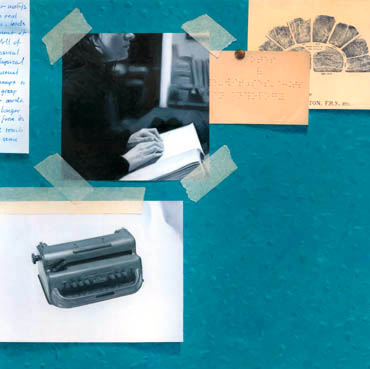
Expanding on the theme of The Five Senses, this painting uses a photograph of the painting for Touch, as its central image. The theme of the sense of touch seems to be entirely appropriate for a trompe l'oeil painting. The full text quoted in handwriting on the piece of paper at the left hand side of the painting reads:

The tendency to project motifs toward the viewer, into real three-dimensional space, leads to a permanent involvement of the sense of touch. All of the aforementioned classical anecdotes entail a physical reaction directed to actual contact: the birds attempt to land and peck, the man seeks to grasp the curtain and pull it aside. When the object is no longer optically distinguishable from its representation, the sense of touch becomes a corrective to the sense of sight.*

The other elements in the painting are a scrap of Braille, and at the lower left of the picture, the Perkins Brailler, which is essentially like a typewriter for producing Braille. The fingerprints are those of Francis Galton, who pioneered the science of finger-printing in Britain. All the elements of the picture are displayed against a background of wood-chip wallpaper, an appropriately tactile setting.

*Deceptions And Illusions: Five Centuries of Trompe l'Oeil Painting, Sybille Ebert-Schifferer, National Gallery of Art, Washington, 2002

back

©copyright 2005 Nicholas Middleton